OpenThai 2.0: one open model that reads Thai documents, knows Thailand, and calls tools

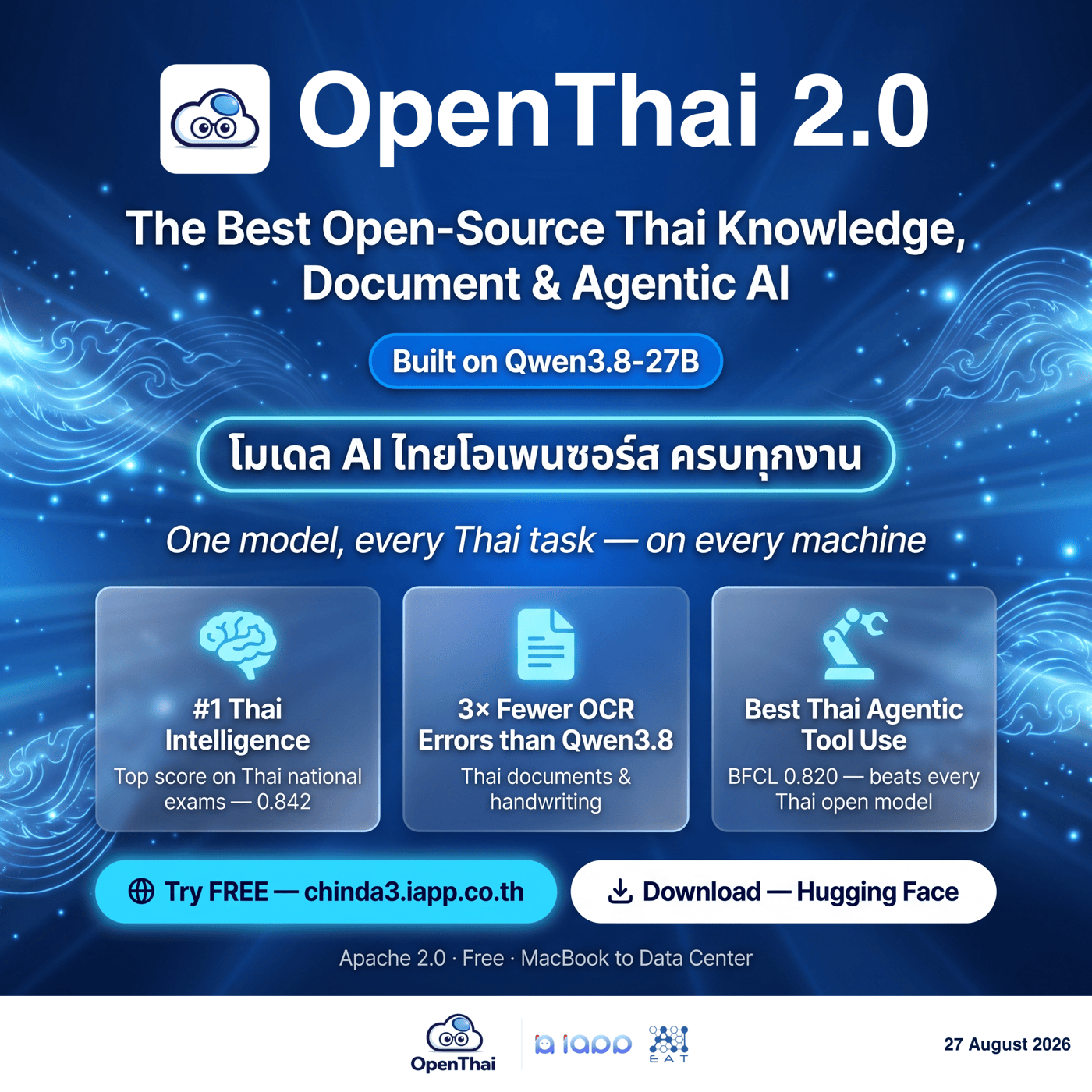
Today we are publishing the weights for OpenThai 2.0 (openthai2.0-qwen3.8-27b), a 27B model released under Apache 2.0 and free to download from Hugging Face for research and commercial use alike.
What sets it apart is not any single score. It is that three capabilities live in one set of weights — reading Thai documents and handwriting, answering questions about Thailand, and calling tools as an agent — with no separate OCR stage and no handoff between systems.
Why one model matters
Most Thai document systems today are pipelines: send the image to a specialist OCR model, get text back, then pass that text to a second LLM to answer questions about it. Every seam is a place where information falls out — layout is lost, tables break, the reader's confidence never reaches the answerer. And when the answer is wrong, you cannot tell whether the reading step or the answering step failed.
OpenThai 2.0 is the only open Thai model in our comparison that reads documents at close to specialist level and answers questions about them itself. The pixels and the knowledge share the same weights.
The numbers that matter
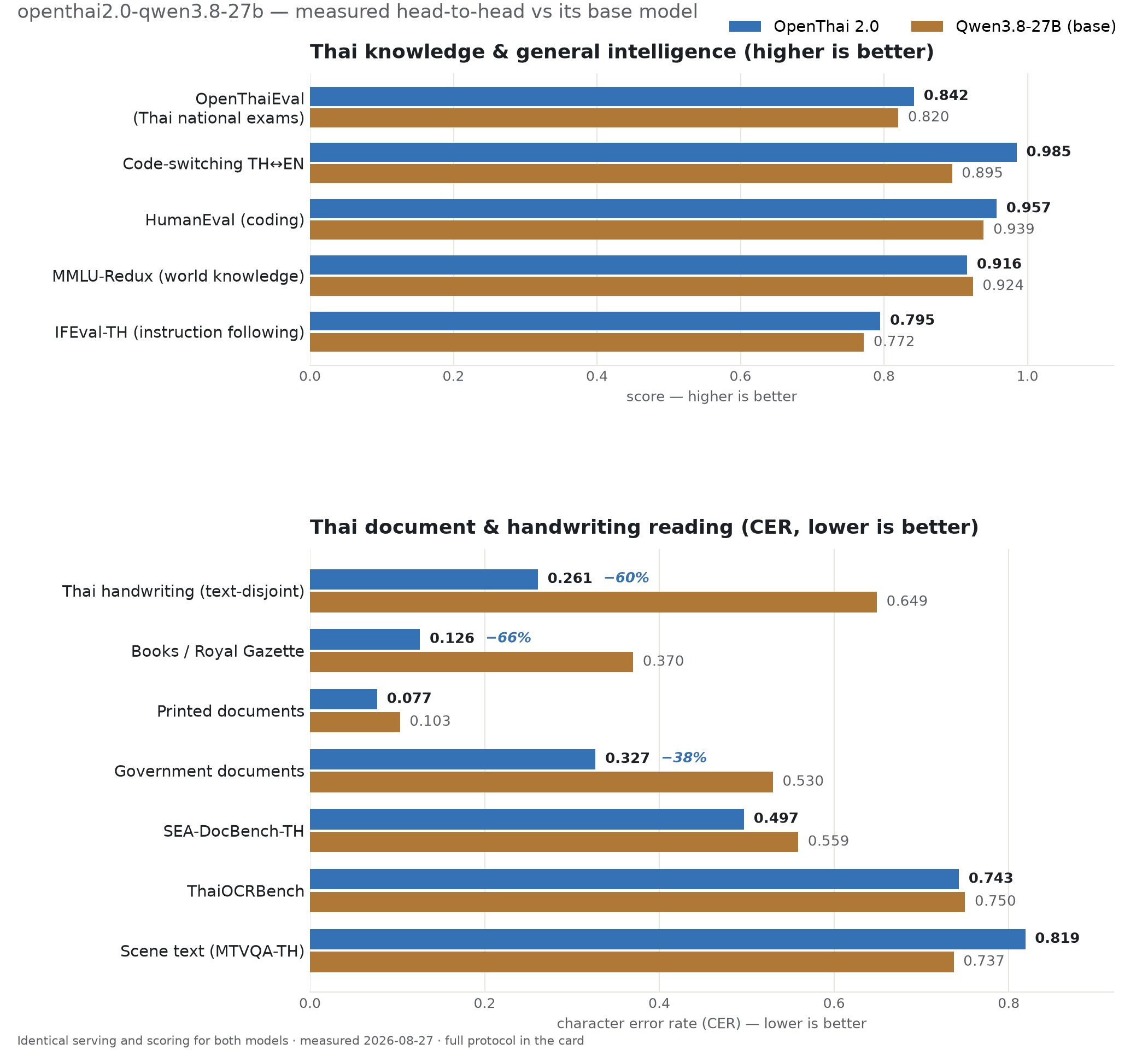
Thai handwriting. Character error rate falls from the base model's 0.649 to 0.261 — 60% fewer errors. Books and the Royal Gazette land at 0.126 against the base model's 0.370, a 66% reduction.
Thai knowledge. 0.842 on OpenThaiEval, a suite of Thai national examinations, ahead of the base model (0.820), Typhoon 2.5 (0.742) and Pathumma (0.660). Thai instruction following (IFEval-TH) reaches 0.795.
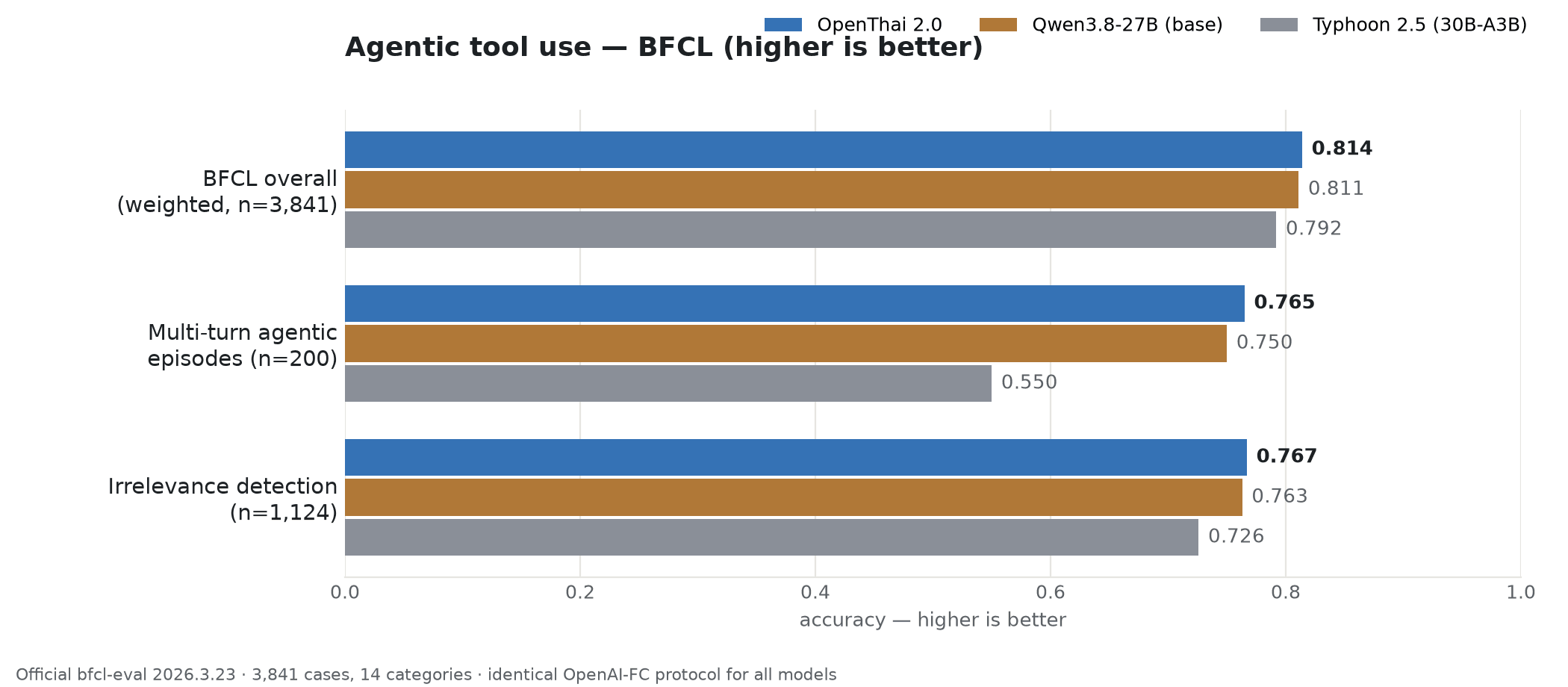
Agentic work. 0.820 on the Berkeley Function-Calling Leaderboard, ahead of both the base model (0.811) and Typhoon 2.5 (0.792). The gap is widest on multi-turn agentic tasks, where it scores 0.775 against Typhoon's 0.550 — 22.5 points.
Something we weigh just as heavily: tuning for Thai documents did not cost the model its other abilities. It still writes code at 0.957 on HumanEval, and English general knowledge (MMLU-Redux) sits at 0.916 against the base model's 0.924.
Where this model falls short
We would rather you read the results straight than see only the flattering ones.
Typhoon-OCR 1.5 still beats us at pure transcription. On clean printed lines and text-disjoint handwriting it outperforms every model in our tables, ours included. But transcription is all it does — one fixed prompt shape, no document question answering, no knowledge or assistant ability.
Scene text is our weakest reading skill. If your work is signage or shopfronts, reach for the base model or a dedicated scene-text model instead.
The model explains by default. Requests for a short answer succeed only about 40% of the time. If a machine will parse the output, state the format explicitly — "reply with JSON only".
Handwriting remains genuinely hard. A CER of 0.261 means roughly one character in four is still wrong on difficult samples, and the model can invent text where the original is illegible. For factual and regulated work, pair it with retrieval and human review. For legal work specifically, OpenThai 2.0 Legal is purpose-built.
Getting started
The fastest route is Ollama, in one command:
ollama run openthai/openthai2.0-qwen3.8-27b
Five formats cover everything from a MacBook to an NVIDIA Blackwell server — bf16, GGUF (17/29 GB), MLX 4-bit for Apple silicon, INT8 W8A8 and NVFP4 — plus a standalone LoRA adapter (7 GB, rank 64) for anyone who would rather serve it on the base model with dynamic LoRA.
The checkpoint also ships a multi-token prediction head. Turn on self-speculative decoding in vLLM and we measure 75.2 tokens/second against 50.1 without it — 50% faster on an H100 — with token-identical output, because the main model verifies every token the draft head proposes.
If you would rather not run a GPU at all, iApp hosts an OpenAI-compatible API that is free until 30 September 2026 with a free API key.
Before you serve it yourself
Do not set a low max_tokens — the model thinks before it answers, and capping at 1,024 returns an empty answer roughly a third of the time. With vLLM you must pass --max-num-seqs 128: the hybrid architecture reserves one state-cache block per decode sequence, and vLLM's default stops the engine from starting.
Use enable_thinking: false only for image transcription requests. For plain text, leave thinking on.
Thanks to our sponsor
Training and evaluation ran on eight NVIDIA H100 GPUs donated by Siam AI Corporation. Thank you for your continued support of open Thai AI.
OpenThai 2.0 was built by iApp Technology and released together with the Artificial Intelligence Entrepreneur Association of Thailand (AIEAT), on the Qwen/Qwen3.8-27B base model.
Read on: the full launch announcement with every benchmark table · download on Hugging Face · try it free in your browser